

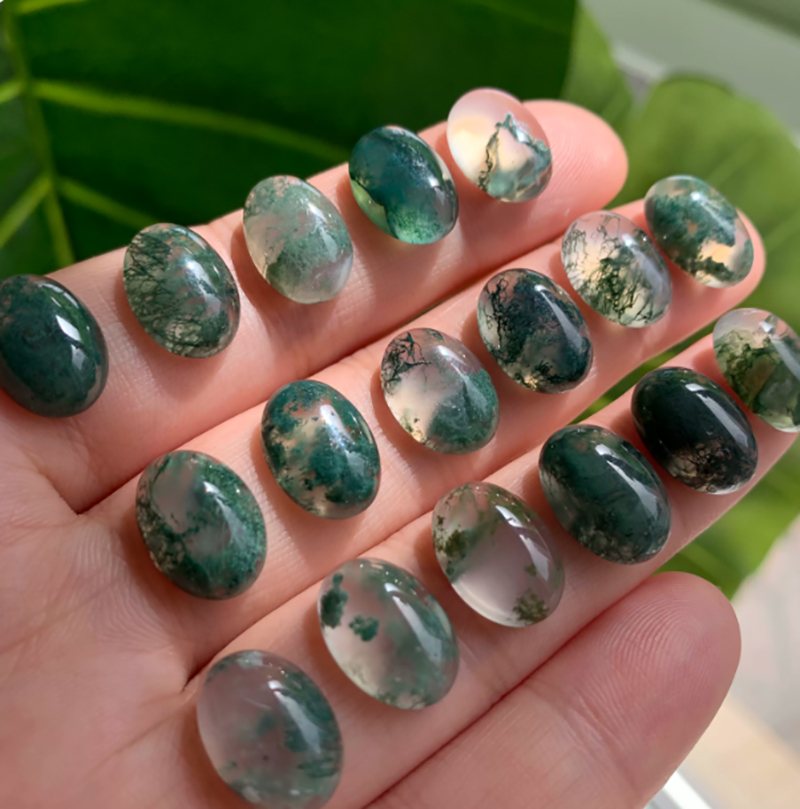
Unlike gemstones admired primarily for their brilliance, Moss Agate is distinguished by its intricate mineral inclusions, which resemble delicate branches, ferns, and miniature forest landscapes.
But how does a piece of rough Moss Agate become a polished gemstone, and how does its cut influence the way its colors and patterns are revealed?
1. What Is Moss Agate?
Moss Agate is a variety of chalcedony, a microcrystalline form of quartz, characterized by its plant-like mineral inclusions. Despite its name, it contains no actual moss or plant material. These natural inclusions, which may contain chlorite and other iron-bearing minerals, vary in color, density, and distribution, giving each gemstone its distinctive appearance.
2. From Rough Stone to Lapidary Art
Moss Agate begins as an unassuming piece of rough stone, its beauty hidden within. Cutting Moss Agate is about more than achieving a desired shape—it is about framing a natural landscape.
A lapidary artist examines the rough stone for its internal patterns, transparency, and fractures before selecting the cutting orientation. The stone is then sliced, shaped, and polished, with careful attention to how the inclusions are positioned within the finished gemstone.
3. Popular Moss Agate Shapes and How They Frame the Pattern
Cabochon cutting is a traditional and widely used approach for Moss Agate, offering a smooth surface that emphasizes its internal patterns. Faceted cuts provide an alternative, introducing subtle reflections and geometric detail. In either style, the gemstone's outline helps frame its inclusions, from delicate ink-wash branches to dense forest-green clusters.
 |
 |
| Cabochon Cut A smooth, polished surface that emphasizes the internal patterns. |
Faceted Cut Geometric facets introduce subtle reflections and visual dimension. |
Popular Moss Agate Shapes

Oval: A broad, balanced outline provides ample space for layered branches and scenic landscapes.
Pear: The tapered point emphasizes flowing, directional patterns, complementing vine and leaf-inspired designs.
Round: A symmetrical outline suits inclusions that cluster at the center or radiate outward.
Hexagon: Defined geometric edges contrast with organic mineral patterns, creating a contemporary appearance. Both regular and elongated hexagons provide a distinctive frame for branching inclusions and layered natural landscapes.
Kite: Angular lines complement diagonal and asymmetrical patterns, offering a distinctive choice for alternative jewelry designs.
Larger stones may reveal more of the internal landscape, but cutting orientation and pattern definition are more important than size alone.
4. How to Choose a Quality Moss Agate
Moss Agate has no universally accepted grading system, but five characteristics can help you assess its quality and appearance.
-
Pattern Clarity: Look for well-defined inclusions that clearly resemble branches, ferns, or moss.
-
Color & Transparency: Look for a pleasing contrast between the inclusions and the surrounding background. Clear or translucent areas can add depth and definition, while denser green formations create a richer, more dramatic appearance.
-
Cut & Polish: Look for a well-proportioned shape, a smooth surface, and a cutting orientation that complements the natural inclusions.
-
Cracks & Fractures: Examine the gemstone for surface-reaching fractures, chips, and vulnerable edges, especially when choosing a stone for everyday wear.
-
Treatment: Unusually uniform or vivid coloration may warrant further investigation. Ask the jeweler whether the gemstone has been dyed or otherwise treated.
5. Frequently Asked Questions
Is Moss Agate durable enough for an engagement ring?
Yes, with proper care. Moss Agate has a Mohs hardness of approximately 6.5–7, making it more susceptible to scratches than diamonds or sapphires. It can also chip under impact. A protective setting, such as a bezel, can help minimize damage.
Is Moss Agate worth buying?
Moss Agate offers distinctive mineral patterns at a generally more accessible price than diamonds. Its individual character makes it an appealing option for nature-inspired and alternative engagement rings.
Is every Moss Agate unique?
Yes. Its mineral inclusions form naturally, creating individual patterns even in gemstones cut from the same piece of rough material.
Does Moss Agate fade?
Untreated Moss Agate generally retains its natural color under normal wearing conditions. Dyed or treated stones may behave differently, so it is worth asking your jeweler about any treatments.
How do I care for a Moss Agate ring?
Clean it with lukewarm water, mild soap, and a soft brush. Avoid ultrasonic cleaners, steam cleaning, harsh chemicals, and hard impacts. Store it separately from harder gemstones to prevent scratches.
What does Moss Agate symbolize?
Moss Agate is traditionally associated with growth, stability, and a connection to nature, making it a meaningful choice for nature-inspired engagement rings.
Discover Your Own Landscape with Lucky Gemstones
At Lucky Gemstones, we celebrate the individuality of every Moss Agate gemstone. Inspired by its intricate mineral patterns, our designs combine carefully selected gemstones with botanical details and refined craftsmanship.
Explore our Moss Agate engagement ring collection and discover a piece that reflects your personal connection to nature.
Inspired by Nature. Crafted with Purpose.